
Content
- Intro
- Scoville: what it is / isn’t
- History selection – Timeline + story
- Organoleptic method – steps + limits
- Modern HPLC method – what’s measured & how it becomes SHU
- Why SHU varies so much – grouped factors
- Myth vs fact (10 items)
- Chillihead mini-gems
Beginner Intro
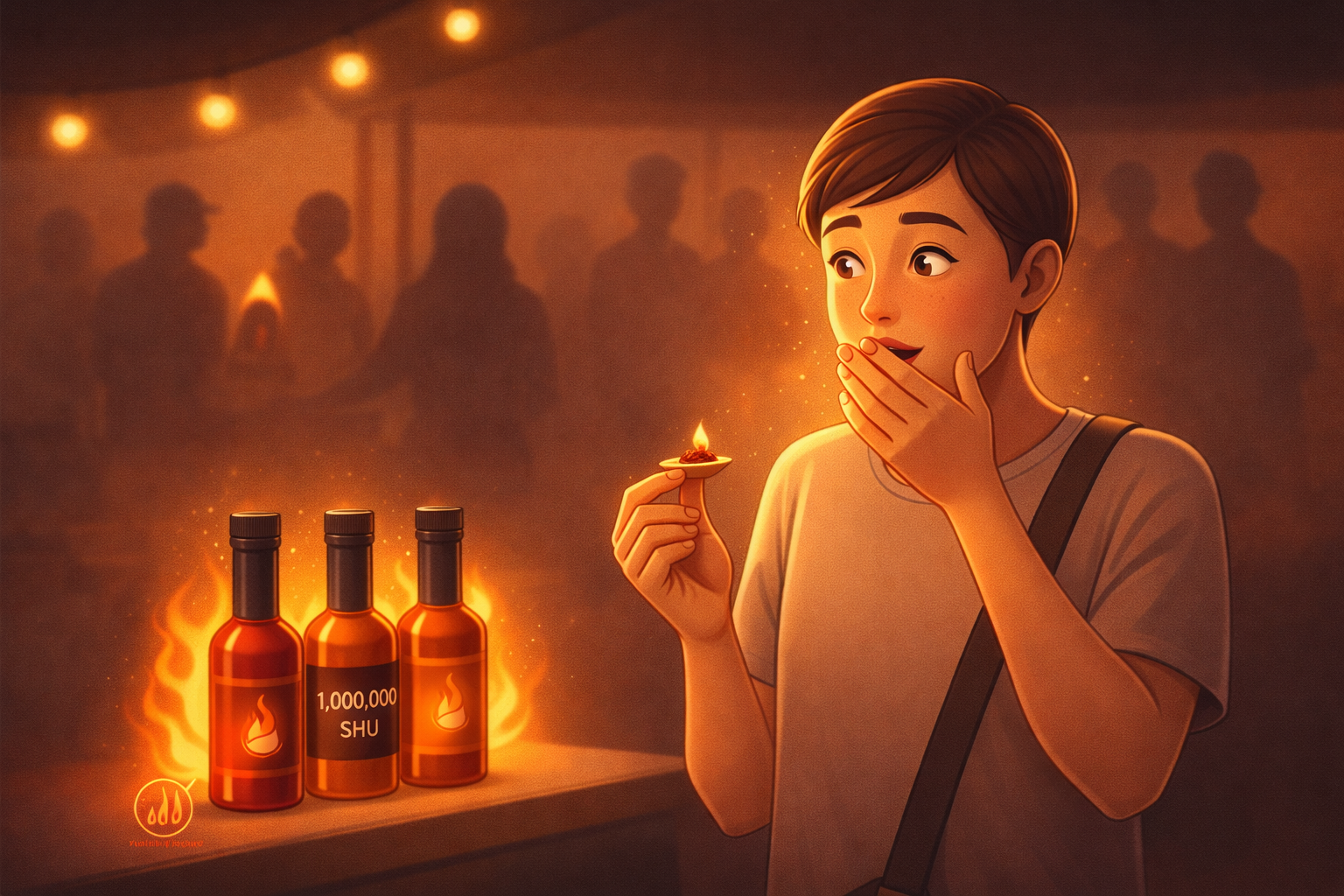
On a Saturday market, you follow your nose to the hot sauce stall. Bottles glow ruby and orange, labels shouting “1,000,000 SHU!” and “Reaper-level heat.” The vendor offers you a tiny sample on a cracker and, because there’s a small crowd watching, you say yes. Your tongue lights up, your ears buzz, and someone asks the classic question: “How many Scovilles is that?”
Those Scoville Heat Units (SHU) are the chilli world’s unofficial bragging rights: a number meant to capture how much burn a pepper or sauce can deliver, based on the concentration of capsaicinoids—the family of compounds led by capsaicin that trigger heat receptors in your mouth. But as you’ll see, that number is part science, part story. (Source: 1; 2)
Scoville: what it is / isn’t
Beginner layer – The yardstick of chilli culture
The Scoville scale is a way of rating how “hot” a chili pepper (or pepper product) is, using Scoville Heat Units (SHU). Higher SHU means a higher concentration of capsaicinoids, especially capsaicin and dihydrocapsaicin, the main molecules that cause the burning sensation. Bell peppers sit at 0 SHU, many jalapeños around a few thousand, and super‑hots like Carolina Reaper and Pepper X climb well above a million SHU. (Source: 2; 3; 4)
Crucially, Scoville is not a direct measure of pain—it’s a chemical concentration index. Your nerves respond via TRPV1 receptors, which fire to both high temperature (typically above about 43°C in vitro) and to capsaicin, so your brain interprets “chemical attack” as “burning heat.” Two people tasting the same SHU can experience very different levels of suffering or pleasure, depending on tolerance, expectation, and even whether they like spicy food. (Source: 1; 5; 6)
Chillihead bonus – what scoville really measures (and ignores)
Technically, modern SHU values are derived from the summed concentration of several capsaicinoids—usually capsaicin plus a weighted contribution from dihydrocapsaicin—measured in parts per million and then converted using an industry factor (15 or 16) to approximate “Scovilles.” That means the Scoville number is tightly tied to dried‑mass chemistry, not directly to how your mouth actually feels. It also mostly ignores minor pungent compounds (e.g., nordihydrocapsaicin, homocapsaicin), as well as context: acidity, temperature, texture, and your nervous system’s state.
Think of SHU as: “If an average lab sample of this pepper were dried and analyzed, here’s about how much capsaicinoid fire is on board,” not “This is exactly how much it will hurt you.” (Source: 2; 4; 5; 7; 8)
History section – timeline + story
Pre‑1900s – Pain without numbers
People in chilli‑growing cultures clearly knew some peppers were hotter than others, but there was no standardized way to compare pungency beyond experience and local naming. (Source: 9)
1912 – Wilbur Scoville’s organoleptic test
Pharmacist Wilbur Scoville at Parke‑Davis develops the Scoville Organoleptic Test to quantify pepper heat for pharmaceutical formulations, using human tasters and sugar‑water dilutions. (Source: 2; 9)
Mid‑20th century – Scoville spreads
Food and spice companies adopt Scoville’s method; panels of tasters sip increasingly diluted pepper extract until heat is barely detectable, generating SHU values that spread into cookbooks and marketing. (Source: 2; 10)
1980s–1990s – HPLC and ASTA pungency units
High‑performance liquid chromatography (HPLC) becomes the standard lab method for quantifying capsaicinoids, with the American Spice Trade Association (ASTA) defining “pungency units” that can be converted to Scoville units. (Source: 2; 4)
2000s–2020s – Super‑hots and record races
Breeders push Capsicum genetics to extremes, producing peppers like Ghost Pepper, Trinidad Moruga Scorpion, Carolina Reaper, and Pepper X, officially measured in the 1–2.6 million SHU range under specific test conditions. Marketing increasingly focuses on the single highest lab result ever achieved by a variety, not the everyday average. (Source: 2; 3; 11)
Story – How a lab test became street-market bragging rights
Scoville didn’t set out to start a macho heat‑eating culture; he was trying to standardize peppers for medicinal use. Working at Parke‑Davis in 1912, he found that existing chemical assays did not match what people actually felt when tasting different peppers, so he turned to psychophysics: dilute pepper extract in sweetened water until trained tasters just barely detect the burn, then use that dilution factor as the heat number. The method was ingenious but subjective, yet it gave industry a repeatable scale and a simple story: more dilutions = more heat. (Source: 12)
Over decades, that lab‑bench psychophysics leaked into kitchens, cookbooks, and sauce labels. As modern labs replaced taste panels with HPLC, Scoville’s name stuck: ASTA “pungency units” are quietly converted back into SHU because “1,000,000 Scovilles” sounds way more fun on a bottle than “66 ppm capsaicin equivalent.” Today, when someone in a street market or hot wing bar asks “How many Scovilles is this?”, they’re unknowingly invoking a 1912 pharmaceutical psychophysics experiment. (Source: 2; 4; 13)
Chillihead bonus – a psychophysics scale that refuses to retire
Psychophysicists have long known that human magnitude estimates of capsaicin heat don’t grow linearly with concentration; perceived intensity follows power‑law relationships and is shaped by adaptation and context. Yet Scoville numbers—nominally linear with capsaicinoid concentration—won the branding war. Even as labs moved to HPLC and capsaicin‑specific methods that can detect capsaicinoids down to fractions of micrograms per kilogram, marketing kept the old units. That tension—between rigorous analytical chemistry and folk‑friendly psychophysical numbers—is exactly where today’s confusion and hype live. (Source: 4; 14)
Organoleptic method – steps + limits
Beginner layer – how the original taste-test worked
Scoville’s original test starts with dried pepper, not fresh pods. A known weight of dried chili is dissolved in alcohol (ethanol), which pulls out the capsaicinoids because they dissolve well in alcohol and fats but poorly in water. This alcohol extract is then diluted in sugar water. A panel of around five trained tasters is given increasingly stronger dilutions until a majority—at least three—can just barely detect the characteristic chilli burn. (Source: 2; 9; 10)
The Scoville rating corresponds to how much the extract had to be diluted before that threshold. If a solution needed 50,000 parts sugar water to one part extract before the burn disappeared, that pepper was rated 50,000 SHU. Bell peppers contain essentially no capsaicinoids and so register 0 SHU; habaneros can reach hundreds of thousands of SHU in this test. (Source 2; 9; 15)
Limits – why tongues make messy instruments
The organoleptic test is charmingly human and brutally flawed. Sensitivity to capsaicin varies widely between people due to differences in nociceptor density, genetics, and prior exposure. Tasters also experience sensory fatigue: after a few samples, the tongue adapts and becomes less responsive, which limits how many peppers can be reliably rated in a day and inflates variability between labs. (Sources: 2; 5; 9; 14)
Because the method relies on detection thresholds rather than actual chemical measurement, results can differ by around ±50% between different laboratories and panels. It also blends all capsaicinoids (and even non‑capsaicinoid irritants) into a single “heat” judgment, which can miss interesting differences in capsaicinoid profiles. (Sources: 2; 8)
chillihead bonus – organoleptic as cultural artifact
From a chili‑culture standpoint, Scoville’s organoleptic test is the original “panel of chiliheads in lab coats.” It’s literally psychophysics applied to street‑food pain. That historical subjectivity still echoes today in tasting panels and YouTube “challenge” content, even though industrial labs moved on. Psychophysical work on capsaicin shows how rating scales, instructions, and adaptation protocols can systematically skew intensity judgments, which helps explain why organoleptic SHU values often overshoot what HPLC later reports for the same material. In a sense, the old Scoville test was always as much about human psychology as about the pepper itself. (Sources: 14; 16)
modern HPLC method – what’s measured & how it becomes SHU
beginner layer – from pepper powder to lab number
Modern labs usually measure chili heat with high‑performance liquid chromatography (HPLC) or faster variants like ultra‑fast LC. The process looks roughly like this:
- Dry the pepper sample (or use dried product) and grind it to a uniform powder.
- Extract capsaicinoids with a solvent like acetonitrile or ethanol.
- Inject the extract into an HPLC system, which separates the individual capsaicinoids and quantifies each peak using UV detection.
- Calculate total “pungency” based mainly on capsaicin and dihydrocapsaicin, then convert that concentration (parts per million of heat, ppmH) into Scoville Heat Units.
This makes the measurement much more precise and repeatable than relying on human tasters. Labs validated UFLC/HPLC methods with limits of detection for capsaicin on the order of 0.045 µg/kg and good linearity and recovery, meaning they can accurately quantify capsaicinoids even at low levels.
Translation to SHU – 15 or 16?
Under the ASTA framework, pungency in ppmH is calculated by combining capsaicin and dihydrocapsaicin peak areas with a weighting factor (typically 0.82 for dihydrocapsaicin) relative to a capsaicin standard. Scoville heat units are then obtained by multiplying ppmH by a factor; in many references this factor is 15, while others use 16 on the basis that pure capsaicin is about 16 million SHU per kilogram. (Sources: 2; 4; 7; 17)
For example, an analytical study converted capsaicinoid contents (µg/kg) in various genotypes into SHU using the relationship that about 10 µg/kg capsaicinoids correspond to 15 SHU. Another reference simply states “ppm capsaicin × 16 = SHU,” explicitly noting that this reflects capsaicin’s ~16 million SHU rating. These are approximations rather than immutable physical constants, which is why different sources sometimes disagree by a modest percentage. (Sources: 4; 7; 17)
What’s not measured (or not captured perfectly)
HPLC, as usually implemented, focuses on capsaicin and dihydrocapsaicin, which together often make up 80–90%+ of total capsaicinoids, but it may underweight or ignore minor capsaicinoids and other pungent TRPV1 agonists. It also measures chemical concentration, not subjective burn: factors like temperature of the food, pH, fat content, and even your expectations can change how intense the same capsaicinoid dose feels. (Sources: 2; 4; 5; 8; 18)
Chillihead bonus – why HPLC SHU often looks “lower” than the legend
Industry and independent discussions consistently report that HPLC‑based SHU values for the same peppers are often 20–40% lower than those reported by old organoleptic methods. Taste panels can be influenced by cumulative burn and by any trace pungent compounds not captured in a simple capsaicin+dihydrocapsaicin model, while modern methods stick to a restricted definition of “heat” based on specific analytes. That’s why the lab report on your favorite “2.2 million SHU” chili might come back closer to 1.4–1.8 million for typical pods: the chemistry is more conservative than the legend. (Sources: 2; 8; 11; 16; 19)
Why SHU varies so much – grouped factors
- Different Capsicum species and cultivars have dramatically different capsaicin and dihydrocapsaicin levels; analyses of multiple genotypes find total capsaicinoids ranging from non‑detectable to over 20,000 µg/kg in dried samples, translating from 0 to over 230,000 SHU in one controlled study. (Source: 4)
- Screening of diverse pepper lines shows capsaisin concentrations in fresh fruits ranging from less than 1 µg/g to hundreds of µg/g, even within a single species. (Sources: 8; 20)
- Capsaicinoid content changes during fruit development and ripening; several studies report increasing capsaicinoid levels as peppers mature from green to fully ripe stages. (Sources: 4; 14; 20)
- Within a plant, fruits at different nodes or on sunnier vs shadier sides can show significant differences in capsaicinoid levels, reflecting micro‑environmental and developmental variation. (Sources: 8; 21)
- Stress (such as water limitation or other environmental stressors) can increase capsaicinoid production as a defense response, though extreme stress can reduce overall plant vigor. (Sources: 4; 20; 22)
- Because SHU are defined per unit dry mass, drying concentrates capsaicinoids (by removing water) and can change apparent SHU relative to fresh peppers that are roughly 90% water. (Source: 2)
- Capsaicinoids are relatively stable but degrade during prolonged storage; experimental work on dried peppers shows measurable loss of capsaicinoids over months, with storage conditions (temperature, packaging) affecting the rate of decline. (Sources: 11; 21)
- Organoleptic (taste‑panel) methods and HPLC frequently give different SHU values for the same underlying material; HPLC tends to be more conservative and reproducible. (Sources: 2; 16)
- Even with HPLC, total SHU depends on which capsaicinoids are included, what weighting factors are used, and how the conversion factor (15 vs 16) is chosen. (Sources: 2; 4; 7)
- A single pepper pod (or a handful of pods) is often all that’s tested for a marketing claim; yet scientific surveys show within‑variety pungency can vary by an order of magnitude or more across individual fruits or environments. (Sources: 2; 4; 8)
- Producers often market a variety or product using the highest SHU value ever recorded rather than the typical average; for example, the Carolina Reaper’s commonly quoted 2.2 million SHU reflects an extreme outlier, while averages from Guinness‑type testing and independent lab series tend to be notably lower. (Sources: 2; 11)
- Independent lab work and expert commentary regularly find discrepancies between label SHU claims for super‑hot sauces and their measured capsaicinoid content, with many products testing significantly milder than advertised. (Sources: 11; 16)
When you see “up to 2,200,000 SHU” on a label:
- Treat it as a peak under ideal conditions, not a guaranteed experience for every pod or every batch. (Sources: 2; 11)
- Remember it’s usually based on dried material, not the fresh sauce or pod as eaten. (Sources: 2; 23)
- Assume the real‑world average could easily be 20–50% lower than the biggest number on the box. (Sources 11; 16)
Chillihead bonus – when SHU is worth trusting
For comparing varieties tested in the same lab, with clear method descriptions (HPLC, sample size, dry‑mass basis), SHU is extremely useful: it tracks total capsaicinoids quite well and correlates with perceived heat across large differences (e.g., bell vs jalapeño vs habanero). It becomes much less predictive when you compare across labs, across processing (fresh vs sauce vs oil), or across marketing departments that choose different endpoints or conversion factors. In short: SHU is strongest inside a well‑described test context, weakest when used as a free‑floating brag number. (Sources: 2; 4; 8)
Myth vs fact (10 items)
| Myth 1: “A pepper has one true SHU number.” |
|---|
| Fact: Even within a single named variety, capsaicinoid content and SHU can vary by a factor of 10 or more, depending on genotype, environment, maturity, and measurement variability. Scoville numbers are best thought of as ranges or typical values, not exact constants. |
| (Sources: 2; 4; 8) |
| Myth 2: “Scoville units are how much pain you’ll feel, directly.” |
|---|
| Fact: SHU reflects chemical concentration of capsaicinoids, not subjective pain. Perception depends on TRPV1 receptor density, prior exposure, psychological factors, and expectations. Two people eating the same SHU can report very different intensity. |
| (Sources: 1; 5; 18) |
| Myth 3: “The seeds are where all the heat lives.” |
|---|
| Fact: Capsaicinoids are concentrated mainly in the placental tissue (the white pith/ribs that hold the seeds) and internal membranes, not in the seeds themselves. Seeds can be coated in capsaicinoid‑rich placenta, which is why they taste hot, but they are not the primary source. |
| (Sources: 9; 10) |
| Myth 4: “Water is the best cure for chilli burn.” |
|---|
| Fact: Capsaicinoids are poorly soluble in water but very soluble in fats, oils, and alcohol. That’s why rinsing with water often just spreads the burn, while whole‑fat dairy or oily foods help dissolve and wash away capsaicin more effectively. |
| (Sources: 2; 9) |
| Myth 5: “Modern SHU numbers still come from people sipping chili water all day.” |
|---|
| Fact: Industrial measurement today is dominated by HPLC‑type methods, which quantify specific capsaicinoids in dried and extracted samples, then convert to SHU via standardized equations. Organoleptic tests are now more of a historical curiosity and occasional sensory tool than an industry workhorse. |
| (Sources: 2; 4; 13) |
| Myth 6: “SHU perception is linear—twice the SHU means twice as hot to your tongue.” |
|---|
| Fact: Psychophysical studies of capsaicin show that perceived intensity follows non‑linear functions (often power laws) relative to concentration, and that adaptation and context change the curve. Doubling SHU does not guarantee “twice the pain”; at high levels, many tasters simply hit a ceiling of “maximal burn.” |
| (Sources: 5; 14) |
| Myth 7: “Capsaicin is the only thing that matters for heat.” |
|---|
| Fact: Capsaicin and dihydrocapsaicin typically account for most of the heat (often >80–90% of total capsaicinoids), but other capsaicinoids like nordihydrocapsaicin and homocapsaicin also contribute, and other TRPV1 agonists exist in nature. Standard SHU calculations often down‑weight or ignore these minor actors. |
| (Sources: 2; 4; 5) |
| Myth 8: “A sauce’s SHU is basically the same as the pepper used to make it.” |
|---|
| Fact: SHU ratings are defined per unit dry mass, whereas sauces are mostly water, vinegar, and other ingredients, which dilute capsaicinoids. Heat can also degrade during cooking and storage, so a sauce rarely reaches the raw dry‑pepper SHU of its hottest ingredient. |
| (Sources: 2; 23) |
| Myth 9: “Expectation doesn’t change how hot something tastes—only chemistry matters.” |
|---|
| Fact: A recent fMRI study with 47 participants showed that positive expectations (cues predicting enjoyable spicy sauce) reduced reported spiciness for milder sauces and increased activity in brain regions associated with reward and information integration, while negative expectations increased unpleasantness and neural pain‑signature activation, even with identical capsaicin doses. |
| (Sources: 18; 24) |
| Myth 10: “Scoville applies equally well to any spicy sensation.” |
|---|
| Fact: The Scoville scale is scientifically defined for capsaicinoids in Capsicum; comparison figures sometimes quoted for piperine (black pepper), gingerol (ginger), or resiniferatoxin are extrapolations and not official entries on the chili‑based Scoville scale. They are useful analogies but not part of the original formal definition. |
| (Sources: 2; 5) |
Chilihead mini‑gems
| 1. Capsaicin + dihydrocapsaicin dominance | 2. Weighted chemistry in the SHU math | 3. Pure capsaicin vs resiniferatoxin | 4.Where the burn lives in a pod |
| In many peppers, capsaicin and dihydrocapsaicin together account for over 90% of the total capsaicinoid content, making them the primary drivers of SHU and perceived heat. | ASTA’s HPLC method weights dihydrocapsaicin at about 82% of capsaicin’s “heat” contribution when calculating ppmH, reflecting small potency differences between these two major capsaicinoids. | Pure capsaicin is assigned roughly 16 million SHU, while the plant toxin resiniferatoxin—another TRPV1 agonist—has an estimated 16 billion SHU, about 1,000 times hotter on a molar basis. | Horticultural and sensory sources agree that the highest capsaicinoid concentrations are in the placental tissue and inner walls, not the outer flesh—explaining why scraping out the ribs can massively tame a chili without fully deseeding it. |
| (Sources: 4; 8) | (Sources: 2; 4) | (Sources: 2; 5) | (Sources: 10; 12) |
| 5. Pungency classes by SHU | 6. Genotype spread: from 0 to “why did I do this” | 7. Ghost pepper genetics keep surprising breeders | 8. TRPV1: the molecular reason chili feels like heat |
| Analytical work classifies dried pepper samples into bins like non‑pungent (0–700 SHU), mildly pungent (700–3,000), moderately pungent (3,000–25,000), highly pungent (25,000–70,000), and very highly pungent (>80,000), based on measured capsaicinoids. | A UFLC study of 21 chili genotypes found some with undetectable capsaicin (0 SHU) and others around 237,000 SHU on a dry‑weight basis, highlighting just how much variety breeding and selection can pack into the Capsicum genome. | Studies of Capsicum chinense “ghost pepper” germplasm show large genetic and environmental variance in both fruit yield and capsaicin content, underscoring why one Ghost can be a fruity nibble and another a face‑melter. | TRPV1, the “capsaicin receptor,” is a non‑selective cation channel that responds both to capsaicin and to noxious heat above about 43°C, explaining why your brain mistakes chili burn for physical heat. |
| (Source: 4) | (Source: 4) | (Sources: 25; 26) | (Sources: 1; 5) |
| 9. Capsaicin can both hurt and heal | 10. Capsaicinoids rise with ripening | 11. Capsinoids: the gentle cousins | 12. Lab‑tested super‑hots vs folk charts |
| The same capsaicin that produces intense burning pain when applied to skin or mucosa is used in high‑concentration patches and topical treatments to reduce chronic neuropathic pain by desensitizing nociceptors. | Multiple studies show capsaicinoid levels generally increase as fruits ripen from green to full color, which is why ripe red jalapeños and habaneros often taste noticeably hotter than their green counterparts. | Sweet peppers can contain capsinoids, non‑pungent analogs of capsaicinoids that share some health‑related bioactivities but do not strongly activate TRPV1, meaning they offer some chili chemistry without the burn. | When independent labs test “world’s hottest” sauces and extracts by HPLC, reported SHU values are often much lower than splashy marketing claims, corroborating the idea that promotional numbers frequently reflect theoretical maxima or misapplied pepper SHU rather than actual sauce concentrations. |
| (Sources: 5; 27) | (Sources: 4; 14; 20) | (Source: 20) | (Sources: 11; 13; 16) |
| 13. Expectation “additives” change your burn | 14. One lab has tested tens of thousands of chili samples | 15. Non‑capsaicin TRPV1 agonists spice up the story | 16. Why milk works better than beer |
| In the PLOS Biology hot‑sauce study, spicy‑food lovers who saw cues predicting high spiciness rated the same low‑intensity hot sauce as less spicy and showed increased activity in brain regions linked to reward and integration, while spice‑haters with negative expectations showed more pain‑signature activation and less liking. | Southwest Bio‑Labs, an HPLC‑based chile testing lab in New Mexico, reports having analyzed over 85,000 pepper product samples for Scoville heat and color since the mid‑1990s, reflecting the industrial scale behind those little SHU numbers. | Compounds like piperine (black pepper), gingerol and shogaol (ginger), and camphor can also activate TRPV1 or related pathways, which is why multi‑spice dishes can feel “hotter” than their capsaicin content alone would suggest. | Beer is mostly water and relatively low in fat, while whole milk provides both fat for dissolving capsaicin and casein proteins that can help emulsify and carry pungent molecules away from receptors, making dairy notably more effective in quenching burn than most alcoholic drinks. |
| (Sources: 6; 24) | (Source: 13) | (Sources: 2; 5) | (Sources: 5; 9) |
Sources
- https://en.wikipedia.org/wiki/TRPV1
- https://en.wikipedia.org/wiki/Scoville_scale
- https://pepperjoe.com/blogs/blog/hot-pepper-heat-scale-and-the-scoville-scale
- https://pmc.ncbi.nlm.nih.gov/articles/PMC6271280/
- https://pmc.ncbi.nlm.nih.gov/articles/PMC6273518/
- https://www.scimex.org/newsfeed/our-expectations-can-shape-reality-spicy-food-study-says
- https://www.sizes.com/units/scoville_unit.htm
- https://www.jscimedcentral.com/jounal-article-info/JSM-Environmental-Science-and-Ecology/Diversity-in-Capsaicin-and-Dihydrocapsaicin-Content-in-Hot–Pepper-Genotypes–9428
- https://people.brandeis.edu/~sekuler/SensoryProcessesMaterial/scovilleScale.html
- https://www.hotsauceemporium.co.uk/hot-sauce-emporium/scoville-heat-scale/
- https://spicequestlabs.com/blogs/news/scoville-units-why-the-hype-doesnt-always-match-the-lab
- https://people.brandeis.edu/~sekuler/SensoryProcessesMaterial/scovilleScale.html
- https://scovilleheatlab.com/
- https://pmc.ncbi.nlm.nih.gov/articles/PMC4738735/
- http://jalapenomadness.com/jalapeno_scoville_units.html
- https://spice.alibaba.com/spice-storage-usage-hacks/how-scoville-units-are-measured-science-vs-taste-test
- https://capsaicinpowder.com/scoville-heat-scale/
- https://www.scimex.org/newsfeed/our-expectations-can-shape-reality-spicy-food-study-says
- https://spice.alibaba.com/spice-storage-usage-hacks/scoville-scale-decoded-why-pepper-heat-ratings-lie
- https://pubmed.ncbi.nlm.nih.gov/32212928/
- http://horticultureresearch.net/jah/Quantiication%20of%20capsaicin%20content%20and%20pungency%20variations.pdf
- https://www.atlburns.com/blogs/news/how-growing-conditions-affect-capsaicin-levels-in-chili-peppers
- https://growhotpeppers.com/hot-sauce-scoville-scale/
- https://medicalxpress.com/news/2024-10-hot-sauce-asymmetric-placebo-effect.html
- https://peerj.com/articles/17511.pdf
- https://pmc.ncbi.nlm.nih.gov/articles/PMC11246027/
- https://pmc.ncbi.nlm.nih.gov/articles/PMC7969397/